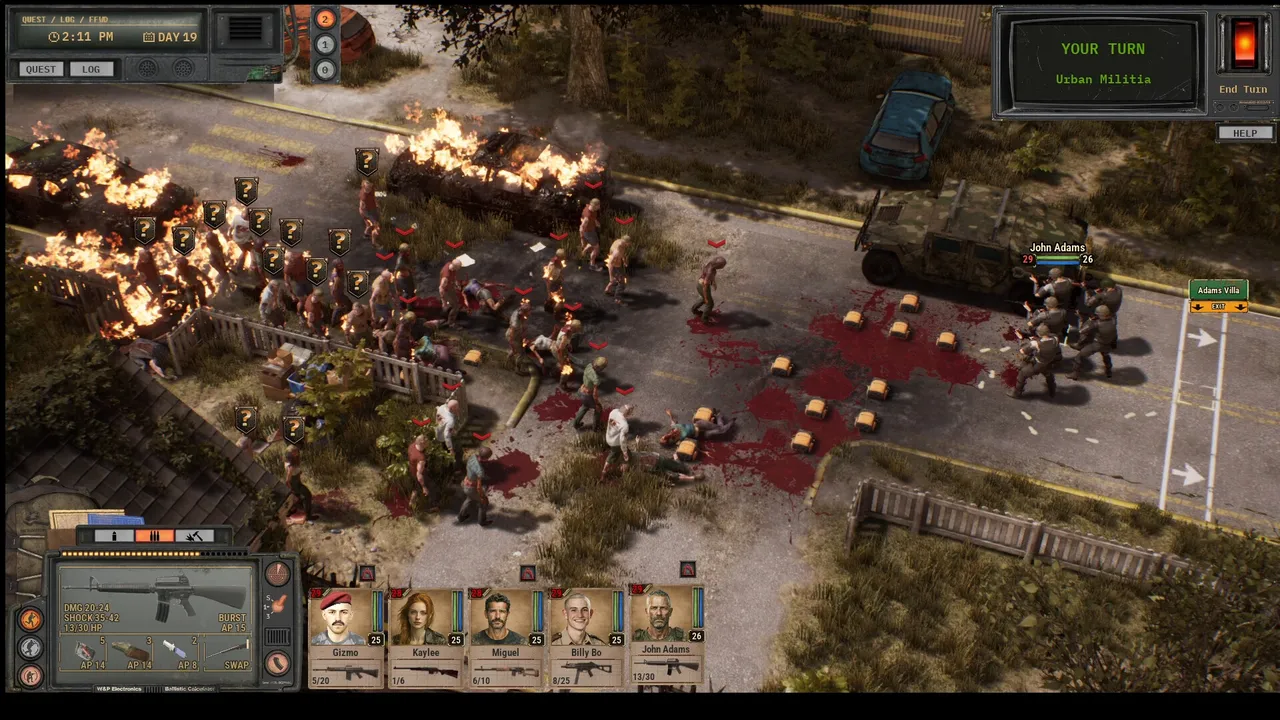
Combat is the core of Urban Strife, and it is unusually physical for a tactics game. Instead of abstract hit percentages, Urban Strife simulates every bullet, pellet and fragment as it flies, so cover, angles and body parts all matter in a way most turn-based games never model. This guide covers how Urban Strife combat actually works and how to win the fights that the campaign throws at you.
Turns and action points
Every battle in Urban Strife is turn-based and runs on action points. Each survivor gets a pool of points per turn and spends them on moving, shooting, reloading, using items and taking cover, in any order you like. That flexibility is central to Urban Strife: you can advance, fire and pull back behind a wall in a single turn if you have the points for it, which makes hit-and-fade tactics viable. Agility raises the movement portion of the pool, while injuries and low stamina shrink it.
Because action points are limited, the skill in Urban Strife is spending them well. A wasted move into an exposed tile can end a survivor, so plan the whole turn before you commit the first point. Reloading, swapping weapons and standing up all cost points too, which is why a clean firing line beats a scramble. Learning to read your action-point budget is the first real step to mastering Urban Strife combat.
Ballistics and shooting through cover
The signature system of Urban Strife is its ballistic simulation. Bullets follow real trajectories instead of rolling against a hit chance, so a shot can pass through a wall, punch through a thin barrier or line up several enemies at once. Shotgun damage is counted pellet by pellet, which means firing into a packed group of undead can wound many of them in a single blast. Grenades throw fragments that each travel their own path, and even explosive rounds behave as physical projectiles.
This changes how you shoot in Urban Strife. Penetration depends on the caliber of your round and the material it hits, so full-metal-jacket ammunition drills through cover that stops a hollow point. You can deliberately shoot through a weak wall to hit someone sheltering behind it, or set up a lane so one high-caliber shot passes through a row of enemies. Understanding Urban Strife ballistics turns the environment itself into part of your arsenal.
Cover, flanking and positioning
Cover in Urban Strife is not a flat percentage bonus; it is the physical object between you and a shooter. Effectiveness depends on material, thickness and angle, so hiding behind a car's engine block stops most calibers, while a wooden fence or a shrub barely slows a round. High, solid cover rewards a flank: if you cannot shoot through it, move a second survivor around the side to fire on the exposed target while the first pins them in place.
Good positioning wins fights in Urban Strife more reliably than raw firepower. Keep survivors spread so a single grenade or a horde cannot catch several at once, hold the high ground where it is offered, and never leave a character standing in another survivor's firing lane, because friendly fire is real. Since the undead react to noise and sight, using cover and darkness to stay unseen lets you choose when a fight in Urban Strife begins.
Body-part targeting
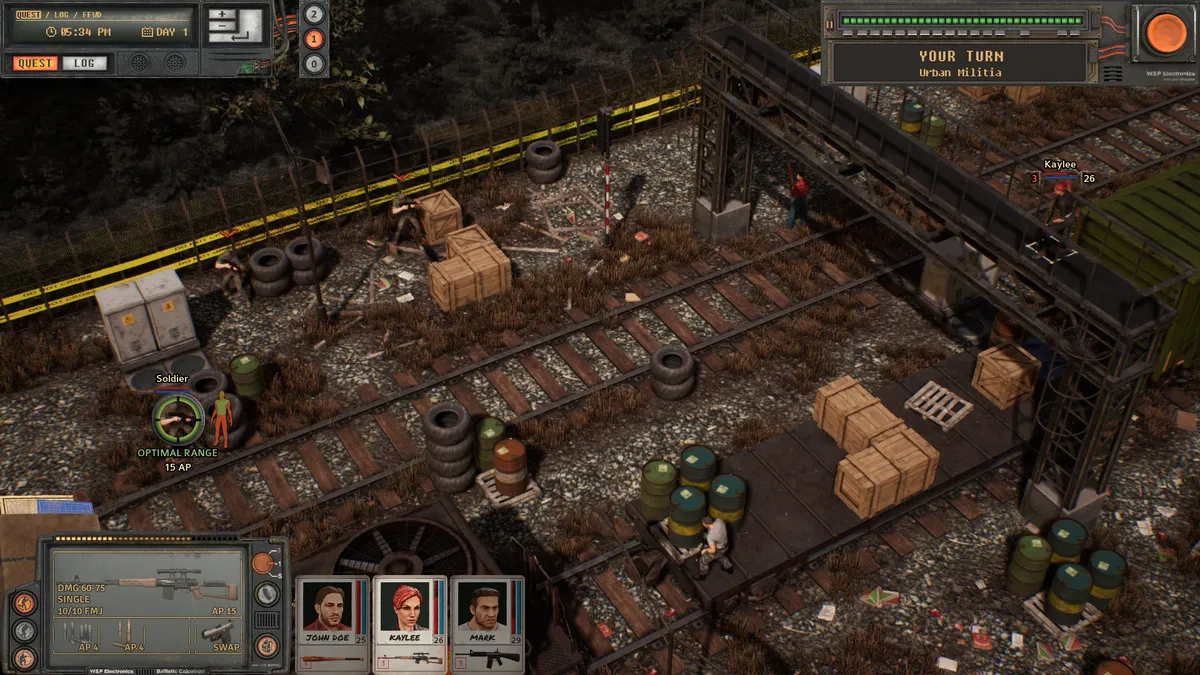
In single-fire mode, Urban Strife lets you aim at a specific body part: the head, the arms, the chest or the legs. Hit chance is shown as a green-to-red shading over the target rather than a bare percentage, so you judge a shot by how the aim reticle colours in. Targeting the head is the reliable way to kill ordinary zombies in Urban Strife, since they take very little damage from hits to any other part.
Limb shots have their uses too. Shooting the legs of a living enemy slows them, and hitting the arms can spoil their aim, which matters against the human factions you may end up fighting. Switching to burst fire trades this precision for volume: you give up body-part targeting and fire at centre mass instead, which is efficient against clustered targets but wastes the single-shot headshots that Urban Strife rewards. Choose the fire mode to fit the target.
Overwatch and interrupts
Overwatch lets a survivor in Urban Strife hold their fire and shoot automatically at any enemy who moves into their line of sight during the enemy phase. It is the backbone of a defensive line: set two or three survivors on overwatch covering a chokepoint, and anything that crosses the open ground takes fire before it reaches you. This is how you turn a doorway or a street into a killzone in Urban Strife.
Interrupts add another layer of timing. Driven by Agility and skill, an interrupt lets a character act during the enemy's turn, reacting to a threat rather than waiting for your next phase. Together, overwatch and interrupts reward players who set traps and control space instead of chasing kills. Against the numbers Urban Strife sends at you, a disciplined overwatch line will out-perform an aggressive push almost every time.
Fighting the undead and hordes
Zombie hordes are a core threat in Urban Strife, and the game handles them with a dedicated simultaneous phase: every undead in a horde moves at once, while each still makes its own decision based on what it sees and hears. That keeps a big swarm tense and fast instead of dragging through dozens of individual turns. The undead react to noise and movement, so you can bait them with a thrown explosive, slip past with careful positioning, or pick them off from stealth with suppressed weapons.
The hardest fight in Urban Strife is the final siege, when the Atlanta Horde reaches Urban Shelter itself. Everything above scales up there: cover, overwatch lines, ammunition and headshots all decide whether the base holds. Stockpile rounds, repair your weapons, and bring your strongest survivors, because once the siege begins there is no scavenging and you fight the climax of Urban Strife with only what you prepared.